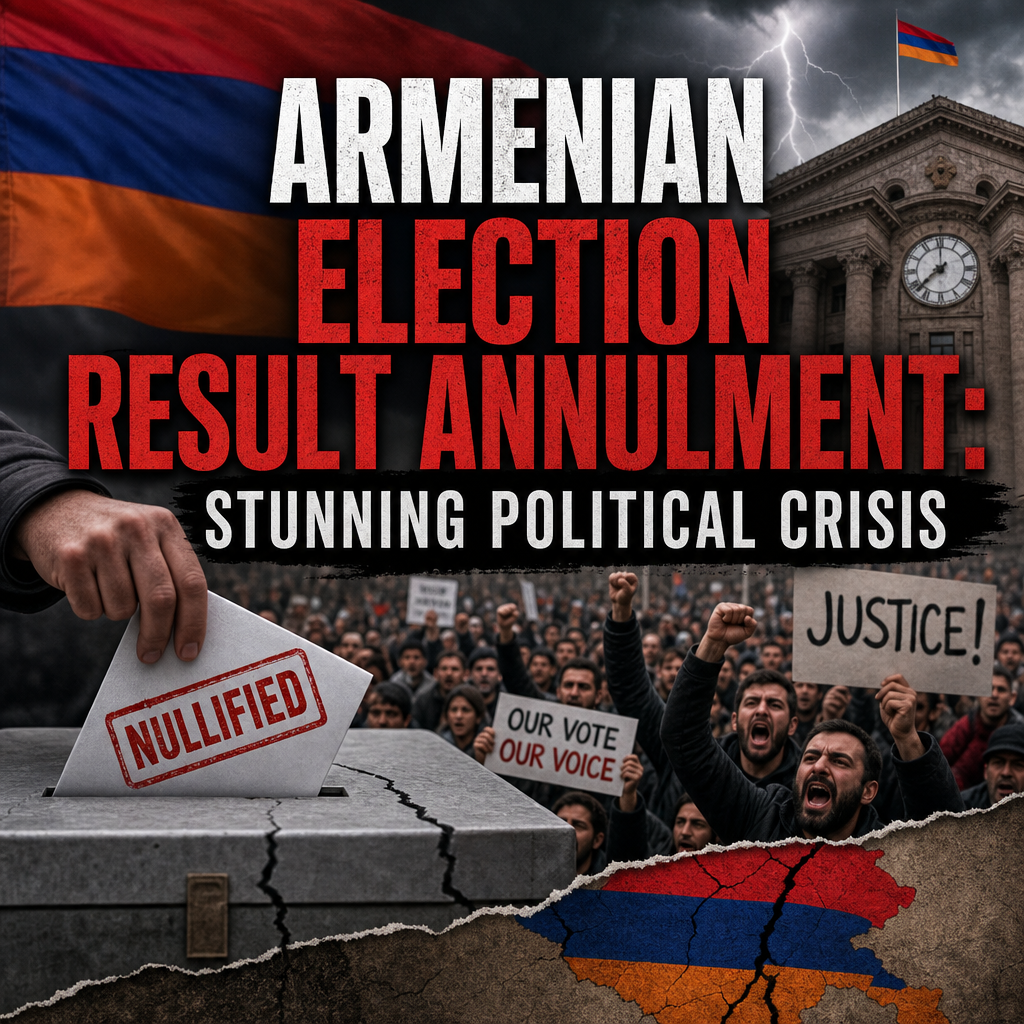
Armenian Election Result Annulment: Stunning Political Crisis


Armenian election result annulment has quickly become more than a procedural dispute; it is shaping up as a test of how fragile the country’s politics have become amid pressure from home, from Moscow, and from an uneasy regional security environment.
What is emerging from the latest reporting is not a simple story of one party refusing to accept defeat, but a broader clash over legitimacy. Al Jazeera’s coverage highlights a pro-Russian opposition party’s demand to annul the outcome, presenting the move as part of a wider battle over whether the election was free, fair, and politically valid. That framing matters because it suggests the argument is not only about numbers on a ballot sheet, but about who gets to define Armenia’s future direction.



A dispute rooted in deeper political fault lines
Armenia has spent years navigating a difficult strategic position. It sits in a tense neighborhood, has a history of dependence on Russia for security, and has faced growing frustration among voters over corruption, governance, and the handling of national security crises. In that context, any contested election result can become a lightning rod.
The opposition’s push for annulment appears to be driven by more than dissatisfaction with the count itself. It reflects a belief that the political system is already tilted, whether through state influence, media pressure, or an uneven playing field. Supporters of annulment typically argue that if the process is compromised, the result cannot be treated as legitimate. That is a serious claim, but it also raises the burden of proof: allegations need evidence strong enough to justify overturning a public mandate.




Here is where the debate becomes complicated. From a democratic standpoint, annulment is a drastic remedy. It may be justified if there are credible signs of systemic fraud, intimidation, or legal violations. But if the evidence is thin, the demand can look like an attempt to reverse an outcome through political pressure rather than ballots. That tension is at the center of the current crisis.
How the crisis looks from different angles
The sources around this story offer contrasting lenses.
Al Jazeera’s reporting places the dispute in a broader regional and political context, emphasizing the role of a pro-Russian opposition force and the instability that can follow when election legitimacy is challenged. That angle underscores the possibility that the contest is not only domestic, but also connected to Armenia’s shifting geopolitical orientation.
RT’s coverage, by contrast, often tends to foreground skepticism toward Western-aligned political narratives and may be more sympathetic to anti-government or opposition claims. Even without leaning on any single report, that perspective is useful because it reflects how some actors interpret the crisis: as evidence that the ruling side may be clinging to power or disregarding serious objections.
Sky News and other international outlets typically approach such disputes from a governance and stability perspective. Their emphasis is often on whether protests, legal challenges, or calls for annulment could deepen polarization or trigger unrest. That framing does not necessarily pick a side, but it does highlight the practical question: can Armenia maintain order and preserve trust in institutions while the dispute unfolds?
Taken together, these viewpoints suggest one clear fact and one clear uncertainty. The fact is that the election result has become politically explosive. The uncertainty is whether the allegations are severe enough to warrant annulment or whether they are primarily a strategic move by losing actors seeking leverage.
Why annulment is such a high-stakes demand
Annulment is not a neutral procedural step. In a country already carrying deep political scars, it can have several consequences:
– It can deepen mistrust in the electoral system if voters feel their choices can be casually overturned.
– It can energize opposition supporters who believe the result was manipulated.
– It can force the government to defend not just its policy record, but the integrity of the institutions that produced the result.
– It can invite outside actors to weigh in, especially when geopolitical loyalties are already contested.
The risk is that every side begins to treat the dispute as existential. For the government, conceding too much may look like weakness and invite further instability. For the opposition, backing away from annulment could be seen as accepting an unfair process. That makes compromise difficult, even if compromise would be the healthiest outcome.
What would count as a credible resolution?
A fair resolution would need to rest on transparent evidence, not slogans. If there were documented irregularities, the public should be able to see them. If the election was broadly sound, authorities should explain the safeguards and publish clear findings. The strongest path forward is usually neither denial nor dramatization, but verification.
That may sound unsatisfying to political actors eager for a decisive win, but it is often the only route that preserves trust. If institutions are weak, every disputed result becomes a constitutional crisis. If they are strong, even serious allegations can be investigated without tearing the system apart.
The broader lesson is that Armenia’s turmoil is about more than one disputed vote. It reflects a country balancing sovereignty, security, and democratic legitimacy under immense pressure. The demand for annulment may prove justified, exaggerated, or somewhere in between. For now, the responsible conclusion is that the case remains unresolved and should be judged on evidence, not on the intensity of the rhetoric around it.
What happens next will matter well beyond one election cycle. If Armenian leaders handle the dispute transparently, they may strengthen public confidence. If they do not, the crisis could harden into a deeper struggle over who governs, who counts as legitimate, and which external powers can still shape the country’s path.